Understanding Consent and Boundaries In Erotic Photography
When people look at a beautiful nude, they usually see the end result with the perfect lighting, poses, and mood that the photo is supposed to bring. However, what they do not see is everything that happened before the shutter clicked, including one of the most important parts of the process that is never shown - consent. Erotic photography is built on trust, as the model is putting herself in one of the most vulnerable positions a person can be in, which is in front of the camera and a photographer. For that to work, everyone involved needs to know what is happening, what the limits are, and what they are not.
Why Consent Is The Foundation Of Every Shoot
Consent in erotic photography means much more than a model agreeing to take her clothes off for the gallery. It means she knows exactly what kind of shoot she is walking into, how much nudity is involved, how the photos will be used, and who will see them. What it also means is that the model agrees to all of this freely, without pressure, and most importantly, that she can change her mind.
Without consent, even if the photo is perfect, the value behind it is lost. When a model feels pushed or unsure, she will never look good in front of the camera, and experienced viewers can often sense this, even if they cannot explain why.
On the other hand, when a model is safe and in control, she tends to give her best work, because she can focus on expression and creativity instead of worrying about what might happen. Because of this, consent is not just a legal box to tick, but something that makes the whole creative process possible, and every respected studio in the industry treats it that way.
Consent Starts Long Before The Camera Comes Out
Most people think consent happens on the day of the shoot, but in reality, it is much earlier. The first conversation between a model and a photographer already sets the tone. Professional photographers will explain who they are, show previous work, and describe the kind of shoot they have in mind before asking for anything. From there, both sides usually work out the details, such as where the shoot will take place, whether it's implied, artistic, or glamour nudity, and who else will be on the scene of the shoot.
Many photographers share mood boards or example photos so the model can see exactly what they are imagining. If you have read our post on how erotic models get discovered, you already know that a lot of careers start with a simple message, and that first message is where good habits begin. This early stage is also where models do their own homework, such as checking out the photographer's portfolio and asking other models about their experience. The FTC's guide on modelling scams is a good example of the warning signs people should watch out for, such as pressure to decide quickly or requests for money upfront.
The Paperwork That Protects Everyone
Once a model agrees to a shoot, the next step is the paperwork, and while it might not sound exciting, it is one of the most important parts of the process. The first thing any reputable studio will ask for is proof of age and identity. In the US, producers of explicit content are required by law to keep records that verify every performer is an adult, under the rules found in 18 U.S. Code § 2257. Studios in other parts of the world use similar practices, even if local laws do not require this, because verifying age is extremely important.
The second document is the model release. This is the agreement that explains how the photos can be used, where they can be published, and for how long. A good release is clear and specific, and it should tell the model whether the images will appear on a membership site, in promotional material, on social media, in print, and it should not hide anything in confusing language.
Models are always encouraged to read it carefully and ask any questions that come to mind before signing it. While this paperwork might feel cold and formal, it is necessary to protect both parties. The model knows exactly what she is agreeing to, and the photographer or studio has proof that everything was done the right way.
Talking About Boundaries Openly
Every model has her own limits, and those limits can be very different from one person to another. One model might be completely comfortable with full nudity but not with certain poses, while the other one might prefer implied nudes only, or might not want her face shown at all. None of these choices is wrong, and a professional photographer will never treat anything like this as a problem to work around.
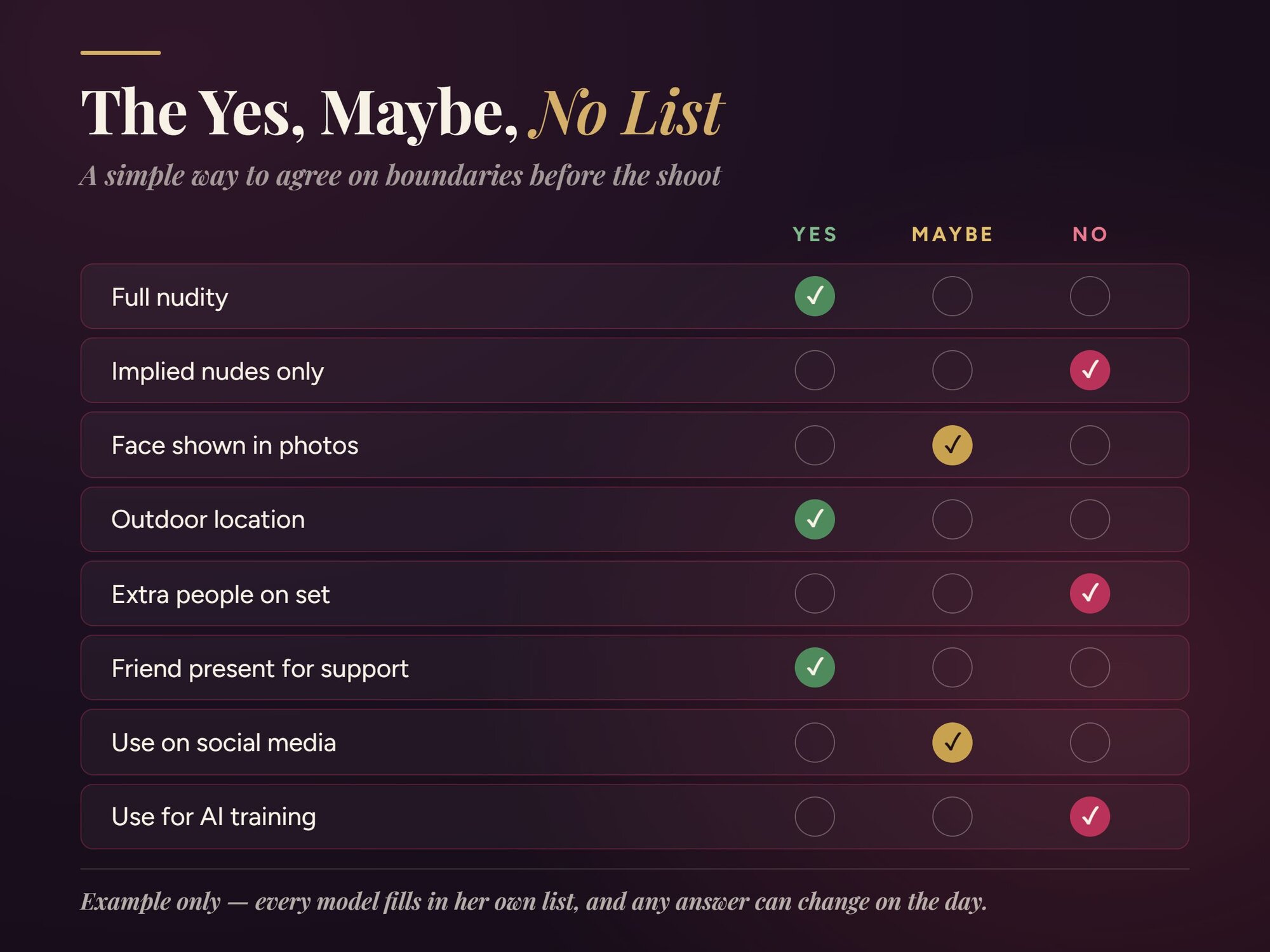
Many studios and photographers use something like a simple yes, maybe, and no list before the shoot, which puts them and the model on the same page when it comes to consent and how to prepare a set. It is a quick and easy way to make sure nobody is guessing.
This is also the moment to talk about smaller details that matter, like if anyone is allowed on set, whether the model can bring a friend for support, whether there will be a break between outfits, whether she sees photos during the shoot, and so on. These questions might seem minor, but they help the model feel comfortable, and this will always show in the final images. We covered a lot of this in our post on how erotic models prepare for a shoot.
Consent Is Ongoing, Not A One-Time Signature
One of the biggest misunderstandings about consent is the idea that once something is agreed to, it cannot be taken back. In reality, consent is ongoing. A model who agreed to something during planning can still change her mind on the day of the shoot, or even in the middle of it, and a good photographer will respect that without arguing. Because of this, photographers will always check in with the model if she is comfortable, and some studios will agree on a simple word or signal that means the shoot should be stopped immediately.
It is also something that works the other way around, where the model who planned to keep things more modest feels the confidence to push her boundaries to something new. This is fine, as long as she is the one who comes up with the idea and not from any kind of pressure from someone else. Any new idea should, of course, be discussed first, and if it goes beyond something that the model was originally comfortable with, it should be added to the paperwork as well.
The Role Of The Photographer
The photographer carries a heavy responsibility on set. Beyond handling lighting and camera settings, they shape the overall environment, which directly impacts how secure and comfortable the model feels. Professional photographers follow a few simple rules, like never touching a model without asking first, explaining what they want instead of physically moving the model into a position, and keeping the set closed to anyone who does not need to be there, while keeping the conversation respectful and professional all the time.
This kind of care is becoming more common across the entire entertainment industry, not just in the world of erotic photography. In film and television, the role of the intimacy coordinator grew quickly after the #MeToo movement, and HBO began requiring them for intimate scenes in 2018. Erotic photography sets are usually much smaller, so a dedicated coordinator is rare, but the idea is slowly spreading.
The best photographers often end up with models who want to keep working with them for years, and it is rarely only because of their technical skills. As many of the models we have talked to in our interviews have said, including Lisa Dawn, feeling comfortable with the person behind the camera is what makes the work enjoyable in the first place.
Consent In The Age Of AI
AI certainly added a whole layer when it comes to this conversation, and today, it is possible to edit a photo so much that it shows something that the model originally never actually did in front of the camera. It can even be used to create nudes of someone who never got in front of the camera to begin with. This is why consent now also covers how a model's image is changed, not just how it is shared.
Many models now ask for clear terms about editing and retouching in their contracts, and some specifically refuse to allow their images to be used to train AI or to create AI versions of themselves. Many studios take this seriously, and it is quickly becoming a standard. We have also looked at how technology is changing the industry, and you can see it in our post on how AI is changing nude and erotic photography.
Why It Matters For Viewers Too
It might seem like consent is something only models and photographers need to think about, but viewers play a part as well. Every time someone chooses where to look at erotic content, they are supporting a certain way of working. Galleries from trusted, professional studios come from shoots where models were verified, informed, and paid. That is not always the case, especially with leaked content or stolen photos. Choosing to browse content from respected sources like the studios featured here on Erotic Beauties is one of the simplest ways to support an industry that treats models with respect.
Respect Makes Better Art
At the end of the day, consent and boundaries are not obstacles to great erotic photography. They are what make it possible. A clear conversation before the shoot, honest paperwork, regular check-ins, and respect for the model's choices all lead to the same result, which is a model who feels confident, comfortable, and free to express herself.
The best photos in our galleries are not just the result of good lighting and beautiful bodies. They are the result of trust between two people who agreed on what they wanted to create together, and when that trust is there, it shows in every single frame of the whole gallery.


Comments (0)
Be the first to comment.